
From Process to Pixels: The Decade-by-Decade Engineering of Modern Sales

From the birth of Consultative Selling to the 2026 AI-driven RevOps paradigm—how industrial, economic, and technological forces built the modern revenue engine.
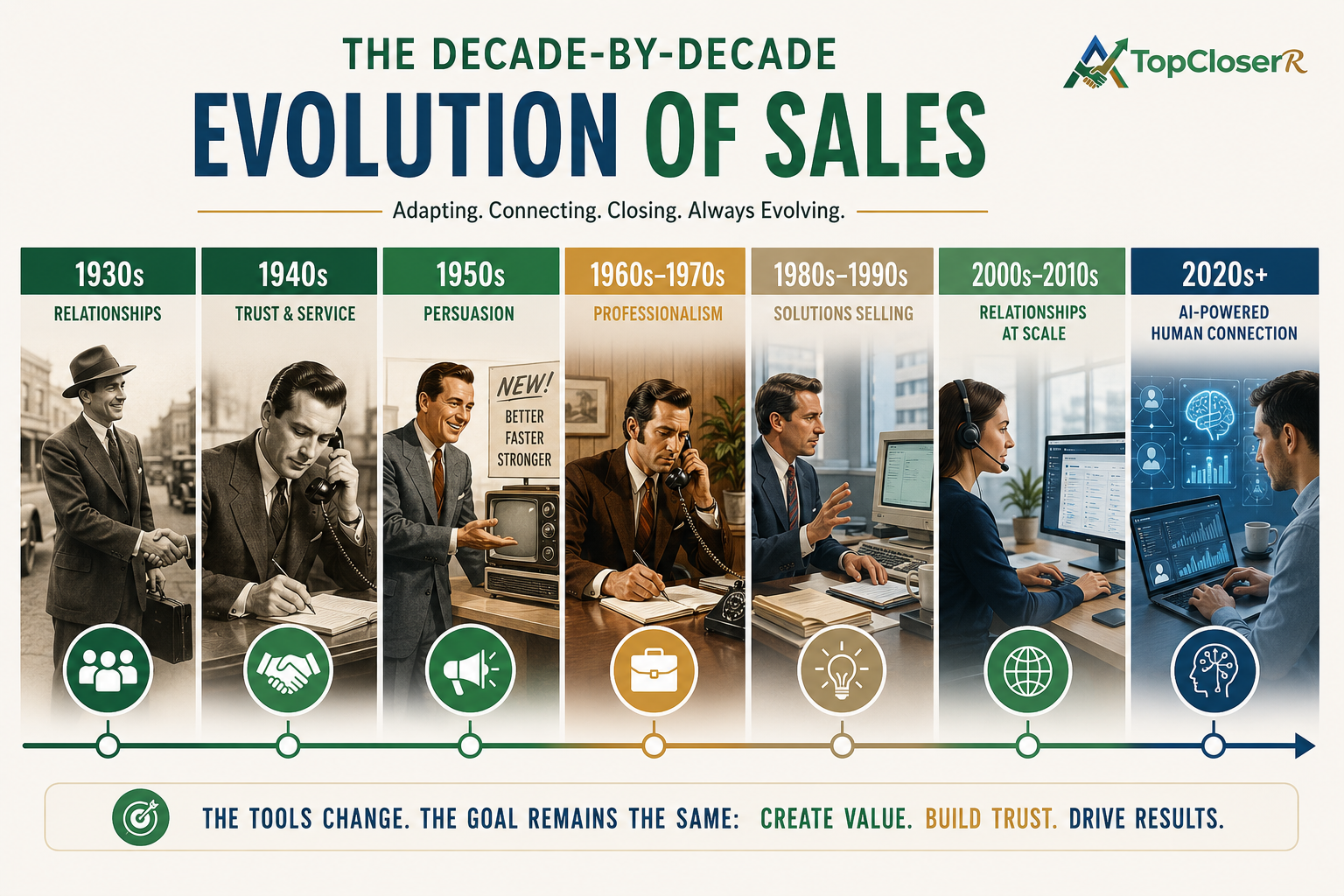
The Historical Architecture
Every time an enterprise revenue team logs a call in a CRM, launches an automated sequencing workflow, or analyzes a buyer’s intent indicators inside a digital sales environment, they are operating within a highly engineered corporate ecosystem. The professional sales industry did not merely adapt to the modern commercial landscape by chance. Over the last seventy years, the discipline was systematically broken down, researched, scientificized, and rebuilt.
Following the structural blueprints laid down by early pioneers like John H. Patterson, sales evolved from a rigid, mechanical script into a highly specialized, data-driven enterprise architecture. To master today’s high-ticket deals, revenue operators must understand the historical and macroeconomic forces that shaped their current pipeline mechanics. This is the decade-by-decade history of the major shifts, breakthrough technologies, and organizational frameworks that built the modern revenue machine.
The 1950s: The Birth of Behavioral and Consultative Models
The post-World War II economic boom fundamentally disrupted the traditional distribution of goods. A sudden, massive surplus of consumer commodities flooded the market, granting buyers multiple options for the exact same product type. Consequently, legacy, high-pressure manipulation tactics failed completely. Sales organizations faced an immediate requirement to adapt.
To navigate this new reality, academic pioneers like E. Raymond Corey alongside corporate giants like General Electric (GE) laid the early groundwork for “relationship marketing” and the “Marketing Concept.” This structural shift dictated that a company must first determine the specific needs of a target market before engineering a product or deploying a pitch.
This behavioral evolution was accelerated by a massive technological infrastructure milestone: the mass adoption of the commercial telephone and television advertising. These tools allowed corporations to warm up target audiences before an account representative ever arrived at a storefront or a residential home, introducing the concept of multi-channel lead validation.
The 1960s: The Era of Formulaic, Process-Driven Corporate Sales
As corporations grew into massive, multi-national conglomerates during the 1960s, revenue operations faced an unprecedented scale challenge. To survive, organizations required a highly standardized, predictable methodology to onboard and train thousands of sales representatives simultaneously.
Enterprise giants like Xerox stepped into the void, investing millions of dollars to develop world-class internal sales training methodologies. This era gave rise to the highly structured Need-Satisfaction model. For the first time, sales professionals were systematically trained to uncover a client’s documented operational needs before attempting to pitch or position a corporate solution.
This shift toward structured internal alignment was further accelerated by macroeconomic government policy. The aggressive enforcement of the Celler-Kefauver Act closed corporate merger loopholes, preventing dominant conglomerates from simply buying up their direct competitors. This placed immense pressure on enterprise sales forces to drive organic growth and successfully open entirely new markets through raw tactical execution.
The 1970s: The Rise of Data-Backed Research and SPIN Selling
By the 1970s, business-to-business sales grew incredibly expensive, highly technical, and deeply complex. Traditional closing techniques that worked flawlessly for small retail items started actively destroying major corporate accounts. A purely transactional approach could no longer sustain high-ticket contract cycles.
To address this friction, Neil Rackham and his research firm, the Huthwaite Research Group, conducted the largest scientific study on sales performance in business history. By analyzing over 35,000 corporate sales calls, they introduced the iconic SPIN Selling methodology (Situation, Problem, Implication, Need-payoff). This framework proved that elite closers win by asking structured, high-intent questions rather than deploying aggressive closing scripts.
Concurrently, hardware infrastructure entered the revenue landscape. The emergence of early mainframe computers, dominated by IBM, allowed large enterprises to track basic client records, billing histories, and manufacturing logistics for the first time, birthing the concept of digital database management.
The 1980s: The Strategic, Solution-Oriented Enterprise Boom
The technology boom of the 1980s injected extreme complexity into the B2B landscape. Corporate buyers were no longer purchasing isolated machines; they were buying highly complex software and hardware systems that required organizational buy-in from multiple corporate departments.
Pioneers Robert Miller and Stephen Heiman introduced Strategic Selling, teaching account executives how to map complex accounts containing multiple stakeholders, separating buyers into distinct roles: Economic Buyers, Technical Buyers, User Buyers, and Internal Champions. Simultaneously, Michael Bosworth pioneered Solution Selling, officially transforming the modern salesperson from a simple vendor into a highly specialized management consultant.
This strategic consulting movement was backed by the commercialization of the personal computer and the earliest desktop databases like ACT!—the world’s very first contact management software. This digital leap officially replaced the physical paper Rolodex and allowed reps to track relationship histories with computational precision.
The 1990s: The Customer Relationship Management (CRM) Revolution
The commercialization of the internet in the 1990s fundamentally restructured how corporate sales pipelines were built and monitored. Prospecting transformed from an un-tracked administrative task into a structured, digital logging system.
Tom Siebel founded Siebel Systems, dominating the decade with the first massive enterprise software built explicitly for sales force automation. Then, in 1999, Marc Benioff founded Salesforce, entirely disrupting the software landscape by introducing the concept of cloud-based customer relationship management (CRM).
This technological explosion occurred alongside massive regulatory shifts. The passage of the Telecommunications Act of 1996 deregulated internet and telecom sectors, sparking a gold rush of technology startups. This hyper-competitive “Dot-Com” era demanded aggressive, highly organized software sales pipelines to capture market share at breakneck speeds.
The 2000s: The Inbound Marketing and Inside Sales Movement
The widespread availability of high-speed broadband internet in the 2000s shifted the balance of power entirely into the hands of the corporate buyer. Prospects no longer required a traveling salesperson to explain product features; they could look up reviews, documentation, and pricing metrics independently online.
Recognizing this shift, Brian Halligan and Dharmesh Shah (the founders of HubSpot) popularized the framework of Inbound Marketing. Instead of relying purely on cold outbound outreach, companies used value-first digital content to pull interested prospects directly into their sales funnels.
Simultaneously, web conferencing tools allowed the massive rise of Inside Sales—selling complex corporate accounts from an office via phone and screen-share. This radically reduced Customer Acquisition Costs (CAC) compared to old-school field travel. This operational pivot became a compliance necessity following the creation of the National Do Not Call Registry (2003), which legally forced sales organizations away from raw phone spamming and toward value-first B2B prospecting.
The 2010s: The Challenger Sale and Predictable SaaS Revenue
The explosion of Software-as-a-Service (SaaS) and recurring subscription models in the 2010s meant that closing an initial corporate contract was just the beginning of the customer relationship. Maximizing Lifetime Value (LTV) and preventing customer churn became top priorities for leadership.
Matthew Dixon and Brent Adamson published The Challenger Sale, proving that the most successful reps win by actively teaching customers new market insights and challenging their assumptions, rather than simply building friendly relationships. Concurrently, Aaron Ross popularized the Predictable Revenue framework, which systematically split the sales role into specialized hunters (SDRs/BDRs) and closers (Account Executives).
This organizational division was fueled by the rise of specialized sales tech stacks. Tools like LinkedIn Sales Navigator revolutionized B2B prospecting, while platforms like Outreach and Salesloft automated email and phone sequencing at a massive, industrialized scale.
The 2020s: RevOps, Conversation Intelligence, and AI Enablement
The transition into the 2020s accelerated a permanent shift toward remote, asynchronous enterprise selling. Digital-first sales became the structural baseline, requiring organizations to destroy data silos across marketing, sales, and customer success teams. This coordination challenge birthed the modern discipline of Revenue Operations (RevOps), unifying all revenue data into a single operational machine.
Pioneers like Gong.io and Chorus.ai disrupted the market with AI-driven conversation intelligence. These platforms systematically recorded, transcribed, and analyzed real-time buyer intent signals across thousands of video meeting hours.
Today, in the 2026 landscape, this infrastructure has evolved into a native system of Generative AI and Large Language Models (LLMs) working alongside human operators. Modern elite closers deploy machine colleagues to automatically draft outreach workflows, analyze real-time buyer intent signals, and provide live, interactive objection-handling prompts directly during complex enterprise deal cycles.
The TopCloserR Takeaway
The modern sales landscape is a masterclass in adaptation. Every time government policies shifted, economic paradigms fractured, or a new technology emerged, the revenue ecosystem evolved its strategy to survive and thrive.
We transitioned from the script-heavy processes of the 1960s, through the strategic methodology eras of the 70s and 80s, straight into the digital, AI-driven pipelines of 2026. Yet, through all this technological engineering, one truth remains absolute: The best closers marry the foundational principles of human psychology with the cutting-edge tools of their era.
Shape the Narrative: We Want Your Insights
Every decade introduces an operational shift that forces underperforming organizations into obsolescence while enriching agile teams.
💬 Historical Strategy Forum
We invite revenue leaders and enterprise sales veterans to join the debate below:
- The Tactical Debate: Which specific historical methodology (e.g., SPIN Selling, Strategic Selling, or The Challenger Sale) forms the absolute core of your live 2026 sales playbook?
- The Modern Horizon: Do you believe the 2026 shift toward AI-assisted sales workflows represents a standard step in technological enablement, or is it a complete break from historical sales processes?
Share your frameworks and operational critiques in the comments section below. Our editorial board evaluates your feedback to shape our upcoming playbooks. For strategic ecosystem partnerships or corporate inquiries, complete our official TopCloserR Contact Form to sync directly with our leadership team.
Leave a Reply