
From Peddlers to Professionals: The Architects of the Modern B2B Selling
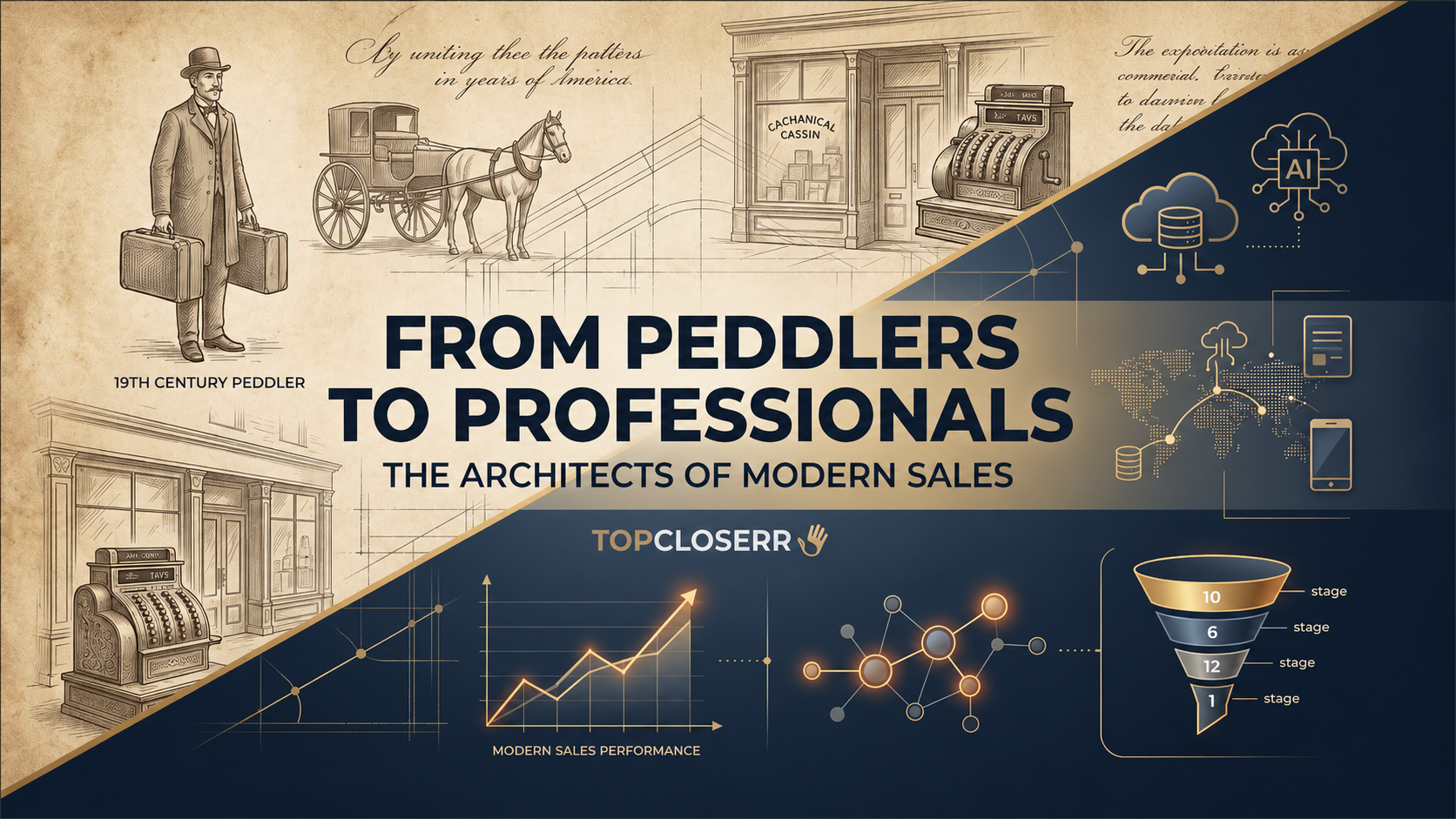
Discover how three visionary pioneers transformed a low-brow traveling hustle into a structured, repeatable science.
The Historical Framework: Identifying the Architects of Modern Sales
Every time you open a modern CRM, audit a pipeline velocity dashboard, or execute a structured revenue playbook, you are interacting with frameworks engineered by the original Architects of Modern Sales. The commercial sales industry did not merely appear through organic happenstance. It was deliberately designed over generations.
Before the turn of the 20th century, selling was the untamed Wild West. Traveling “drummers” and itinerant peddlers roamed the countryside relying on pure grit, deception, and aggressive charm to unload surplus goods. Corporate quotas did not exist, formal training programs were completely absent, and strategic conversion blueprints were entirely unheard of. If you possessed the innate “gift of gab,” you survived. If you did not, you starved.
Between 1880 and 1940, a handful of operational visionaries looked at this chaotic hustle and realized something revolutionary: Selling isn’t an unalterable genetic trait—it is a repeatable science. To master the future of closing high-ticket deals, modern operators must comprehend the architecture of our past. These are the three legendary pioneers who systematically elevated selling from a low-brow hustle into a multi-billion-dollar professional discipline.
1. John H. Patterson: The Godfather of the Sales Playbook
If your current organization utilizes a defined sales territory, a corporate onboarding track, and a tiered commission structure, you owe a direct operational debt to John H. Patterson (1844–1922).
In 1884, Patterson purchased the National Cash Register Company (NCR). At the time, his hardware product was widely disliked. Store clerks actively resisted cash registers because the machines explicitly prevented them from skimming cash from the till. Patterson realized a critical baseline truth: he couldn’t just sell a machine; he had to sell a solution to the business owner.
To scale this strategy, Patterson analyzed his top-performing representatives, documented their exact verbal frameworks, and published the N.C.R. Primer (1887). This monumentally disruptive asset became the world’s very first corporate sales script and formal playbook.
The N.C.R. Primer Formula
Patterson broke every successful transaction down into a strict, four-step mechanical process:
- Approach: Cease acting like a transactional vendor. Position yourself as an expert business consultant to command the buyer’s professional respect.
- Proposition: Introduce the register and clearly explain the explicit financial value statement and ROI.
- Demonstration: Show the product in active operation so the buyer can physically visualize the solution solving their operational friction.
- Close: Secure the commitment using a sharp “assumed close” (e.g., “Should we ship this on Monday or Wednesday?”).
🏛️ The NCR Legacy
Patterson didn’t just build a company; he built a repeatable sales academy. He invented guaranteed sales territories and formalized quota systems. His most famous pupil, Thomas J. Watson, took Patterson’s exact, rigorous sales philosophy and used it to build an international tech empire called IBM.
2. Arthur Frederick Sheldon: The Architect of Sales Psychology
While Patterson perfected the mechanical infrastructure of a transaction, Arthur Frederick Sheldon (1868–1935) dedicated his life to deciphering the human psychology driving why people buy.
In 1902, Sheldon founded the Sheldon School of Scientific Salesmanship in Chicago. He felt deeply frustrated by the predatory, “buyer beware” attitude that dominated early 20th-century commerce. Sheldon argued that sustainable business success was built exclusively on mutual value and trust, popularizing the timeless ethos: “He profits most who serves best.”
Sheldon’s most enduring contribution to modern commerce was the formalization of the AIDA Funnel—the foundational pipeline framework that still governs every modern sales and marketing engine across the globe:
Plaintext
Attention ──► Interest ──► Desire ──► Action
The Law of Suggestion
Sheldon introduced the psychological concept that a buyer has an innate, voluntary resistance to being sold to. To bypass this friction, a salesperson must deploy the “Law of Suggestion.”
By appealing simultaneously to the customer’s cold logic and warm emotions, the rep shifts the sales dynamic from a high-pressure confrontation into an educational collaboration. Sheldon laid the absolute foundation for what we know today as consultative selling.
3. Dale Carnegie: The Master of Empathy-Based Closing
By the time the 1930s arrived, the commercial world had fundamentally changed. The Great Depression hit, corporate budgets vanished, and business buyers grew deeply cynical of aggressive, fast-talking salespeople. The old-school hard sell was dead. Into this economic winter stepped Dale Carnegie (1888–1955).
In 1936, Carnegie published How to Win Friends and Influence People, permanently shifting the sales paradigm from the product to the person.
The Carnegie Selling Blueprint
- Become genuinely interested in other people’s problems.
- Be a master listener; allow the prospect to talk.
- Frame everything explicitly in terms of the buyer’s interests.
- Make the prospect feel important—and do it sincerely.
Carnegie’s core breakthrough was simple yet profound: People do not buy from corporations; they buy from people they like and trust. He taught an entire generation of professionals to stop pitching features and start asking deep, empathetic questions. By shifting the conversational focus to active listening and human empathy, Carnegie proved that the close isn’t a forced event. It is the natural, frictionless byproduct of a mutually respectful relationship.
The Evolution of the Hustle
To understand exactly where the sales industry stands today, look at how these three foundational philosophies build directly upon one another:
| Era | Pioneer | Core Philosophy | The Modern Impact |
| Late 1800s | John H. Patterson | Sales is a structured, repeatable mechanical process. | Playbooks, Scripts, CRMs, Sales Milestones |
| Early 1900s | Arthur F. Sheldon | Sales is a science rooted in psychology and mutual service. | AIDA, Funnels, Consultative Selling |
| 1930s–1950s | Dale Carnegie | Sales is an exercise in human relations and deep empathy. | Relationship Management, Discovery Calls, Active Listening |
The TopCloserR Takeaway
The elite, modern seven-figure closer isn’t utilizing just one of these methodologies. They deploy a fluid hybrid of all three.
To dominate your market today, you need Patterson’s flawless structure to manage your pipeline, Sheldon’s psychological frameworks to navigate the buyer’s journey, and Carnegie’s deep human empathy to build unshakeable trust. Technology, artificial intelligence, and software platforms will continue to change how we track data, but the fundamental mechanics of the human deal remain completely unchanged. Master the roots of your craft, and you will master the close.
Shape the Narrative: We Want Your Insights
Every modern sales motion uses elements engineered by these three foundational architects.
💬 Historical Framework Forum
We invite our community to weigh in below:
- The Operational Paradigm: When you look at your active sales pipeline, do you lean heavier on Patterson’s rigid structures, Sheldon’s funnel logic, or Carnegie’s empathetic relationship building?
- The Tooling Shift: How can modern platforms preserve Carnegie’s core human empathy rules while operating inside an increasingly digital and automated procurement landscape?
Share your tactical breakdowns in the comments below. For guest editorial pitches or enterprise collaboration, complete our official TopCloserR Contact Form to sync directly with our ecosystem team.
Leave a Reply